Whitchurch-Stouffville is really two places. There’s the town — the fast-growing subdivisions around the GO station, full of newer two-storey family homes. And there’s the country — the farmhouses, estate lots, and acreage properties spread across the rural township, many of them decades old and heated by propane, oil, or wood because there’s no natural gas line out there.
The attic matters in both. But the stakes, the problems, and the fixes are different — and if you’re on propane or oil, the stakes are a lot higher. Find your situation below.
First, the universal step: measure what you’ve got
Town or country, the number that matters is the measured depth in your attic today.
- Open the hatch, light on, step only on joists
- Push a ruler to the drywall at several spots, including near the eaves
- Convert:
| Material | R per inch | 8 in | 12 in | 16 in |
|---|---|---|---|---|
| Blown cellulose | ~3.4 – 3.8 | ~R-28 | ~R-42 | ~R-56 |
| Blown fibreglass | ~2.7 – 3.0 | ~R-22 | ~R-34 | ~R-45 |
| Settled batts | ~2.5 – 3.2 | ~R-22 | — | — |
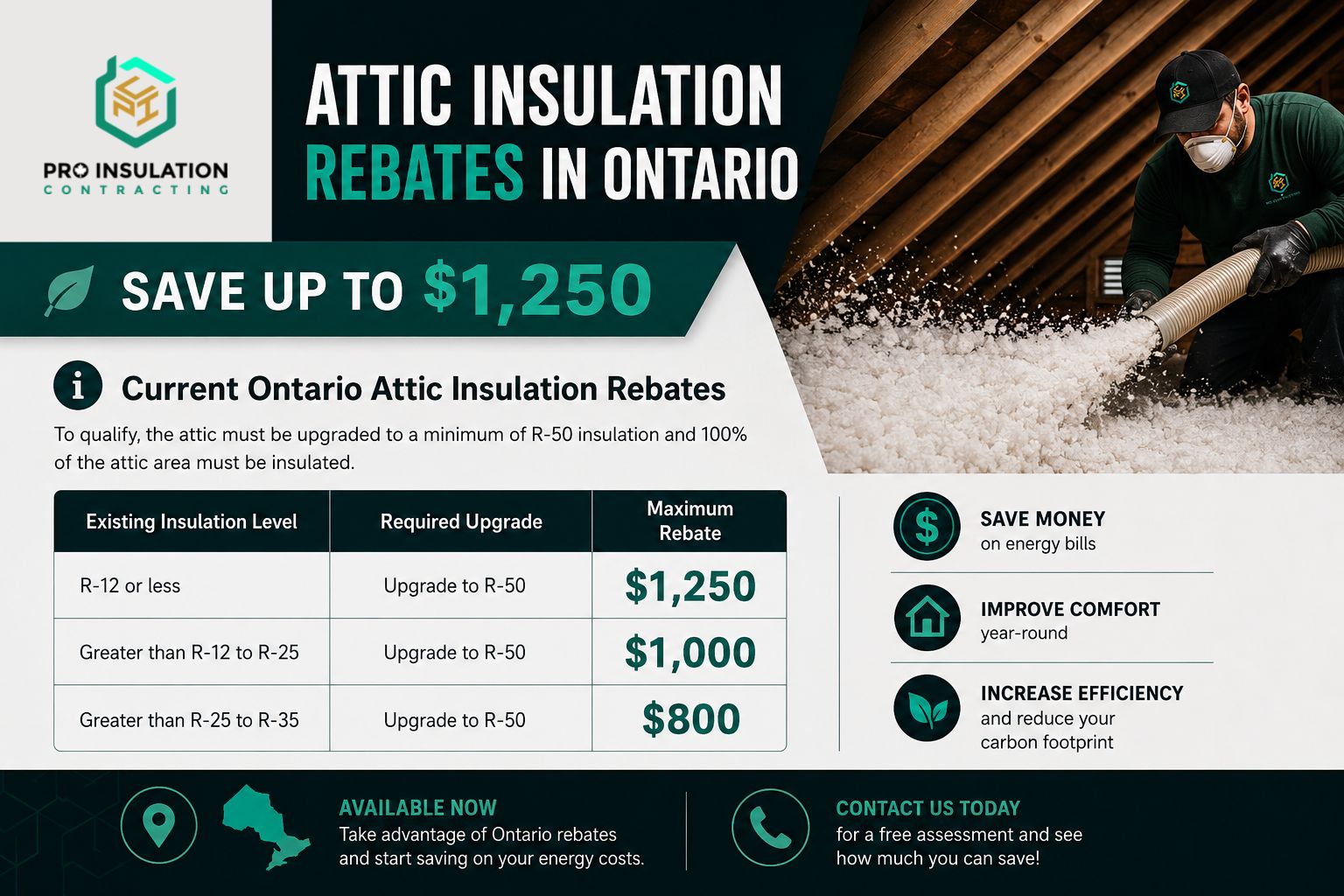
Target: R-50 minimum to qualify for the rebate, R-60 as the goal.
Now to your situation.
If you’re in a newer Stouffville subdivision
The GO-driven growth of recent decades filled Stouffville with newer two-storey family homes. Easier attics — engineered trusses, headroom, proper access — but the usual production-build shortfalls:
Insulated to the minimum of its build year, and settling. Even a 15-year-old home started at that era’s minimum and has lost some depth.
Baffles missing or crushed, the attic hatch left bare, and — the big one — the ceiling never air sealed. Warm air leaks up through unsealed top plates, wiring, plumbing stacks, exhaust fans, and any pot lights added later. Air sealing comes before insulating; skip it and the leaks get buried. Baffle installation →
The cold room over the garage — its floor sits over an unheated garage, not the attic, so an attic top-up won’t fix it. Garage ceiling insulation →
Complex rooflines. Many newer Stouffville homes have multiple gables and bonus rooms, which fragment the attic into separate sections. Each needs checking — measuring at one hatch tells you little.
These homes are usually straightforward to fix well, and on natural gas the savings are solid. But if you’re in the country, read on — because the math changes.
If you’re in a rural or country home (and this is where it gets serious)
The farmhouses, estate homes, and acreage properties across the rural township are a different world, and they share a feature that changes everything: no natural gas. Out here, homes heat with propane, oil, or wood — and propane and oil are expensive.
That single fact makes attic insulation dramatically more valuable in a rural Stouffville home than an identical home in town on gas. Here’s why, and what these homes need.
Why the heating fuel changes the whole calculation
Natural gas is relatively cheap per unit of heat. Propane and heating oil are considerably more expensive. So every unit of heat that escapes through a poorly insulated rural attic costs you far more than the same heat loss would cost a town home on gas.
Translation: if you heat with propane or oil, a thin attic is bleeding money faster than almost anyone in town. The payback on doing your attic right is correspondingly bigger. This is the single highest-ROI insulation situation in the whole Stouffville area, and most rural homeowners don’t realise how much their fuel choice raises the stakes.
What older rural homes specifically need
They often started with very little. Older farmhouses were insulated to whatever standard applied when they were built — frequently very little. Some have almost nothing.
Air sealing is huge here. Old country homes are leaky. Air sealing the ceiling is often the highest-impact single step, more so than in a tighter new home.
Watch for vermiculite in older attics — loose greyish pebble-like granules that can contain asbestos. Don’t disturb it; have it tested. Attic insulation removal →
The walls may need attention too. Old farmhouses often have little or no wall insulation. Where you can’t open the walls, drill and fill insulates them through small holes. On an expensive-to-heat rural home, the walls are worth considering alongside the attic. Drill and fill →
Outbuildings and additions. Rural properties often have additions, wings, and converted spaces added over the years, each with its own (often poor) attic situation. They need checking individually.
The three things that matter in every Stouffville home
Whatever your situation:
1. Air sealing first. Insulation slows heat conduction; it barely touches air movement. Seal the ceiling before insulating.
2. Ventilation and baffles. Blown-in buries soffit vents unless baffles hold it back. Blocked venting causes moisture and ice dams — and Stouffville’s more open, exposed setting (especially rural properties) sees plenty of wind-driven snow.
3. Coverage to the eaves. The perimeter is shorted most often and sits right above your rooms.
What a proper job looks like
- Assess — measure depth, identify material, check for vermiculite (older/rural homes), check venting and penetrations, note the heating fuel (it affects the ROI conversation)
- Test or stop for vermiculite where present
- Remove only if contaminated
- Air seal the ceiling plane
- Install baffles, confirm soffit intake
- Insulate and weatherstrip the hatch(es)
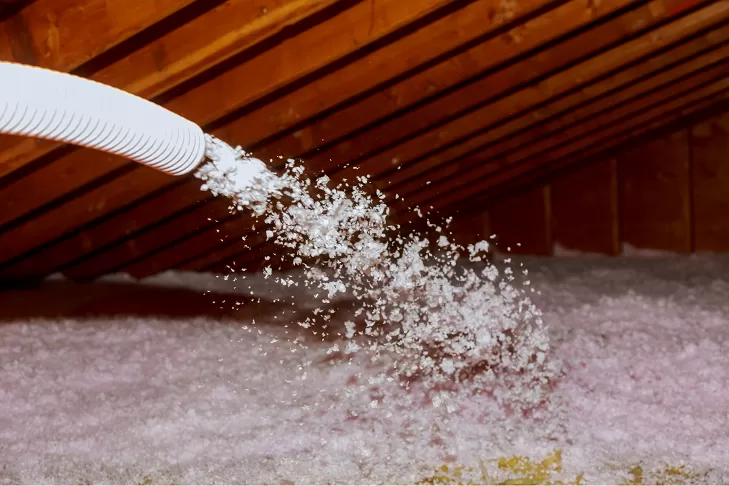
- Blow to depth, out to the eaves — R-50 minimum, R-60 target
- Mark depths so the result is verifiable
On material: cellulose gets more R-value into less depth and is denser (good for leaky older/rural homes); fibreglass is lighter and often cheaper for the same value in a roomy new truss attic. Both are rebate-eligible.
Cellulose blown-in → · Fibreglass blown-in →
Frequently asked questions
I heat with propane. Is insulation really worth more for me? Yes — because propane costs more per unit of heat than natural gas, every bit of heat you stop losing saves you more. Rural homes on propane or oil have the biggest payback on attic insulation in the Stouffville area.
My house is a newer subdivision build. Can the attic still be bad? Often, yes — settling and skipped air sealing are common even in newer homes. And complex rooflines mean some sections may be under-insulated. Measure to be sure.
What’s vermiculite and should I worry? Loose greyish pebble-like granules in some older attics; it can contain asbestos. Don’t disturb it — have it tested before any work.
Do I have to remove old insulation? Only if it’s contaminated by mould, water, rodents or smoke, or if it’s vermiculite needing testing. Otherwise new goes over old and the R-values add.
Do I have to leave home during the work? No.
How long does it take? A straightforward top-up is usually a single day. Larger rural homes, multiple sections, or removal take longer.
Get an assessment that accounts for how you heat
Whether you’re in a new subdivision on gas or an old farmhouse on propane, the right attic work depends on your home and — importantly for rural properties — how you heat it. A proper assessment measures what you’ve got and tells you what the payback actually looks like for your situation.
Pro Insulation Contracting has insulated Ontario homes for over 10 years and serves Whitchurch-Stouffville, town and country. Free on-site assessment, written scope, fixed price before any work starts.
📞 (416) 315-0471 · Book a free attic assessment →